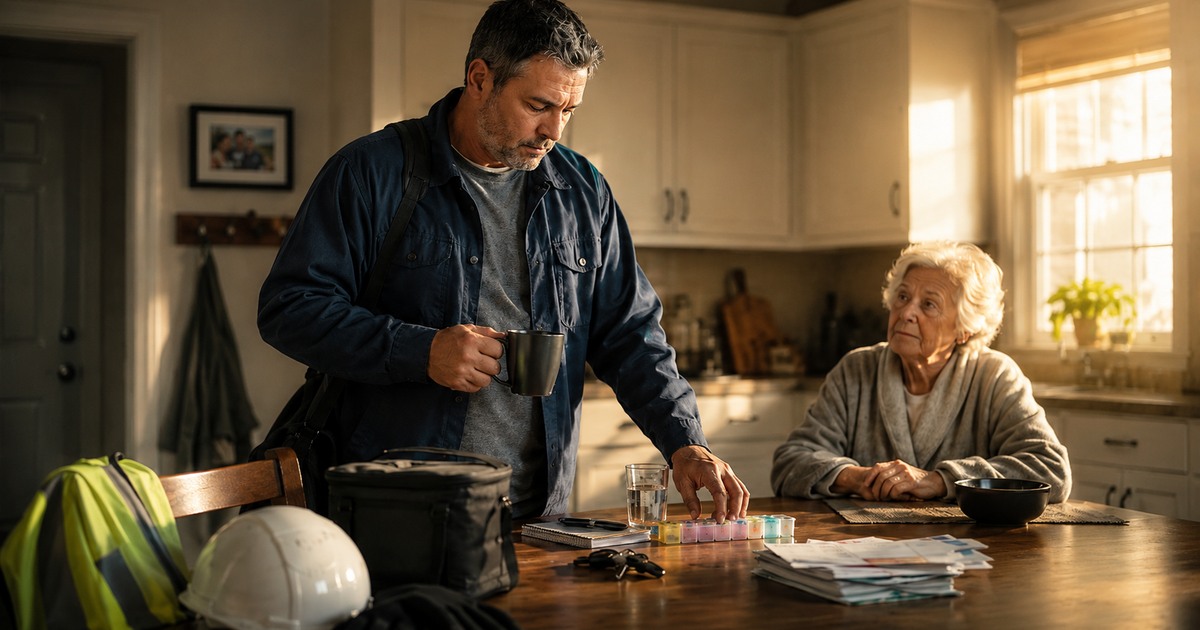
Families often ask one enormous question:
Can Mom or Dad still live at home?
It sounds as though the answer should be yes or no.
Usually it is not.
The better question is whether this person, in this home, with this level of support, this family capacity, these financial realities and these current needs can keep living there in a way that still works.
Home is not only an address.
It is a care system.
That system may include the parent, a spouse, adult children, neighbours, transportation, home care, meal delivery, medications, home maintenance, emergency plans and a hundred small things nobody notices until one of them stops working.
The goal is not to keep an aging parent in the same building at any cost.
The goal is to protect as much independence, control, connection, meaning, safety and dignity as possible.
Staying home is not the only form of independence
Families can fall into a simple equation:
Home means independence.
Moving means losing it.
Real life is more complicated.
An older adult can remain in the family home while becoming isolated, unable to get groceries, frightened on the stairs, dependent on one exhausted caregiver and unable to participate in the community.
Another person may move to a smaller or more supported setting and regain easier access to meals, transportation, activities, friends and help.
Do not judge the decision only by the address.
Judge the life that is possible there.
The Seven Part Home Test
Instead of asking only whether your parent wants to stay home, look at seven parts of the real system around them.
1. The person
Start with what your parent can actually do today.
Can they bathe, dress, prepare food, manage medication, use the bathroom, get around the home, answer the door, use the telephone and respond to an emergency?
What has become harder?
What is changing?
What help do they already accept?
What help do they say they would accept if the need increased?
One difficulty should not become a verdict on the whole person.
At the same time, do not build the plan only around their best day.
Look for patterns and changes that happen often enough that the home system needs to handle them.
2. The house
Sometimes the problem is not the person.
It is the environment.
Look at stairs, bathrooms, laundry, lighting, entrances, flooring, storage, heating, snow removal, yard work and general maintenance.
The National Institute on Aging recommends going through the home room by room, correcting immediate hazards first and then considering changes that make the home safer and easier to use. Simple measures can include better lighting, secure railings, removing trip hazards and adding grab bars where appropriate.
Canada's current fall prevention guidance also emphasizes reducing tripping hazards and adapting the environment rather than assuming falls are simply an unavoidable part of aging.
A grab bar may solve a bathroom problem.
Moving laundry upstairs may solve a stair problem.
Delivery may solve a grocery problem.
Match the change to the actual barrier.
3. The support
“The family will help” is not a care plan.
Which family member?
Which day?
Which task?
For how long?
What happens if that person becomes sick, goes away, returns to work full time or simply reaches their limit?
List the support that actually exists.
Family.
Friends.
Neighbours.
Meal delivery.
Transportation.
Home and community care.
Housekeeping.
Respite.
Emergency response systems.
Then ask what would happen if one important piece disappeared tomorrow.
A strong home plan has some backup.
4. The caregiver's capacity
A parent may appear to be living independently because someone else is quietly making independence possible.
Dad lives at home.
Except his daughter is there every morning.
And again at night.
She does the groceries, medication reminders, appointments, paperwork and emergency calls.
There is nothing wrong with supported independence.
The danger is pretending the support is not there.
Ask whether the person providing most of the care can continue doing it sustainably.
Not heroically.
Sustainably.
Caregiver fatigue, health, work, sleep, family responsibilities and distance all belong in the decision because a home plan that depends on one person collapsing slowly is not a stable plan.
5. The money
Staying home can look inexpensive when family labour is counted as free and home costs are looked at one at a time.
Count the real system.
Home maintenance.
Repairs.
Transportation.
Cleaning.
Meal services.
Paid care.
Equipment.
Property costs.
Lost work or travel for family caregivers where that is part of the reality.
This does not mean every hour of family care needs a dollar value.
It means families should compare options honestly rather than assuming the current arrangement costs nothing.
6. The community
A safe house can still become an isolated life.
Can your parent reach groceries?
Health care?
Friends?
Faith community?
Activities?
The bank?
A pharmacy?
Transportation becomes especially important when driving changes.
A parent living alone may be well supported by neighbours, services, family, transportation and strong social connections.
A parent living with family can still be isolated.
Do not measure support only by who sleeps under the same roof.
7. The night
This is the part many home plans never test.
Everything works at two in the afternoon.
What happens at two in the morning?
If your parent falls, becomes suddenly unwell, needs help getting to the bathroom, becomes confused or cannot reach the phone, what happens next?
Who responds?
Can a spouse respond safely?
Is someone nearby?
Is there an alert system?
Does the person know how to use it?
Does somebody actually receive the alert and have the ability to act?
Technology can extend a care system.
It does not become the care system by itself.
A fall should trigger questions, not an automatic move
Falls matter.
Public Health Agency of Canada guidance identifies falls as a major source of injury for older adults and emphasizes prevention through safer environments, physical activity where appropriate and attention to individual risk factors.
A fall should make the family ask what happened.
Was there a loose rug?
Poor lighting?
Weakness after illness?
A medication issue that needs professional review?
A mobility change?
A pattern of repeated falls?
One fall does not automatically answer where a parent should live for the rest of their life.
Repeated falls or meaningful changes do tell you the current plan deserves reassessment.
Ask what home actually means to your parent
When a parent says, “I am not leaving my home,” the family may hear only the building.
Ask what they are protecting.
The answer might be:
My spouse.
My dog.
The garden.
The neighbours.
Privacy.
My routines.
Knowing where everything is.
The place where my memories are.
If you understand what home means, you may be able to protect more of it even if the care arrangement eventually changes.
Home and community care can change the answer
The choice is not always “stay home with family doing everything” or “move into a care home.”
Home based services can include personal care, nursing, rehabilitation, respite, help with daily activities and other supports depending on the person's needs and what is available locally.
In Alberta, continuing care access is based on an assessment of unmet care needs. Alberta Health Services and the Government of Alberta both direct families to professional assessment when they are unsure what level of support is appropriate. An assessment may identify home and community care or other community supports instead of a move to a continuing care home.
That is an important point.
Do not decide the entire future before finding out what support exists.
Watch for the yellow stage
The best time to act is often before the answer becomes obvious.
The house still works.
But the caregiver is tired.
More help is needed.
Nighttime is becoming harder.
Transportation is fragile.
Falls are becoming more frequent.
Repairs are accumulating.
The current services are barely enough.
This is the stage when choices still exist.
Waiting for a full crisis may create proof, but it can remove options.
The answer can be “Yes, for now”
Families sometimes believe they need one permanent decision.
They do not.
“Yes, Dad can stay home for now, with these supports, and we will review the plan in three months” is a complete answer.
So is:
“No, the current arrangement is not working.”
That second answer does not always mean move immediately.
It may mean more help.
A home modification.
Caregiver relief.
Better transportation.
A professional assessment.
A temporary recovery plan after illness.
Ask what would need to become true for home to work.
Then test whether those changes are realistic.
Do not preserve the building and lose the life
Sometimes the address remains the same while the person's world becomes smaller.
Sometimes the address changes and much of the life returns.
The real measure is not whether the family preserved the original house at any cost.
It is whether the plan preserves as much as possible of the person's control, connection, meaning, safety, dignity and relationships while remaining sustainable for the people providing care.
That is the real question behind:
Can my aging parent still live at home?
Related reading
Signs Your Aging Parents May Need Help Before a Crisis →
What to Do When an Aging Parent Refuses Help →
How to Talk to Aging Parents About Needing Help Without Taking Over →
Sibling Conflict When Caring for Aging Parents →
Long-Distance Caregiving for Aging Parents: How to Help When You Live Far Away →
When Should an Aging Parent Stop Driving? →
When Is It Time to Bring in Outside Help for Aging Parents? →
Related book: When Your Parents Begin to Need You
When Your Parents Begin to Need You: How to Help Aging Parents Before a Crisis, Protect Their Independence, and Keep Your Family Together includes a full chapter on whether a parent can still stay at home, including the Seven Part Home Test, caregiver capacity, real costs, community support and the nighttime test.
Read more about When Your Parents Begin to Need You →
Source note
This article was reviewed against current guidance from:
- National Institute on Aging: Aging in Place, Growing Older at Home
- National Institute on Aging: Home Safety Tips for Older Adults
- Public Health Agency of Canada: Preventing Falls and Injuries for Older Adults
- Government of Alberta: How to Access Continuing Care
- Alberta Health Services: Home & Community Care
Professional boundary
This article provides general educational information about aging, caregiving, home safety and planning. It does not determine whether a particular person can live safely at home and is not a substitute for medical, occupational therapy, nursing, legal, financial or other professional assessment. Sudden or significant changes in health, confusion, mobility, falls or ability to manage essential daily needs should be discussed with an appropriate health professional. Services, eligibility, laws and terminology vary by jurisdiction.