By Donald P Andrechek, Inventor of the TTP Model, TTP Global
A practical Canadian playbook leaders can audit this week.
A Monday start-up at a transit depot in the Lower Mainland. Dispatch is late, two mechanics are finishing Sunday carry-over, and three buses roll without the usual handover. By noon: a door-interlock fault, a brake-light warning, and a near-miss at a stop. None of that shows up on the lagging charts—yet the week is brittle.
The fix wasn’t a bigger dashboard or more posters. It was governing three hidden forces before harm: how fast and faithfully signals travel from observation to verified action (Delta Truth), whether pace is outrunning bandwidth (Tempo–Bandwidth Index, TBI), and how deeply the team has actually practiced what matters (Preparation Depth Index, PDI). With a one-page, evidence-backed dashboard (and triggers that force action within 48 hours), firefighting flattened in weeks, repeat events fell, and on-time performance rose.
“There’s no room for confusion or misunderstanding in health and safety.” — Anne Tennier, President & CEO, CCOHS
“EHS managers have a once-in-a-generation chance to make working life more flexible, modern and safer for everyone.” — Bill Pennington, EHS Today
Why “leading indicators” keep letting leaders down
Counting activities isn’t the same as governing capacity. Activity metrics are easy to game and rarely tell you if truth moves fast enough to matter—or if the pace of work has turned brittle. The strongest features mix story and service journalism: a clear problem, why it persists, and “do-this-now” checklists readers can use this week.
The TTP triad (in one minute)
Delta Truth (0–100).
Faster, faithful signals with verified closure score higher. Time the hops from report → owner → fix; require Physical / Recent / Ownership proof for green.
Tempo–Bandwidth Index (0–100; lower is better).
Blends WIP vs staffing, task switches/shift, overtime, alarm density, meeting load, and schedule slip. Red → reduce pace within 48 hours.
Preparation Depth Index (0–100; higher is better).
Coverage × recency × participation × kit readiness × learning closure (did a lesson produce a verified change at the point of work?).
Canada’s OHS system spans 14 jurisdictions (one federal, ten provincial, three territorial). A single, evidence-backed triad helps leaders speak one language across sites and vendors.
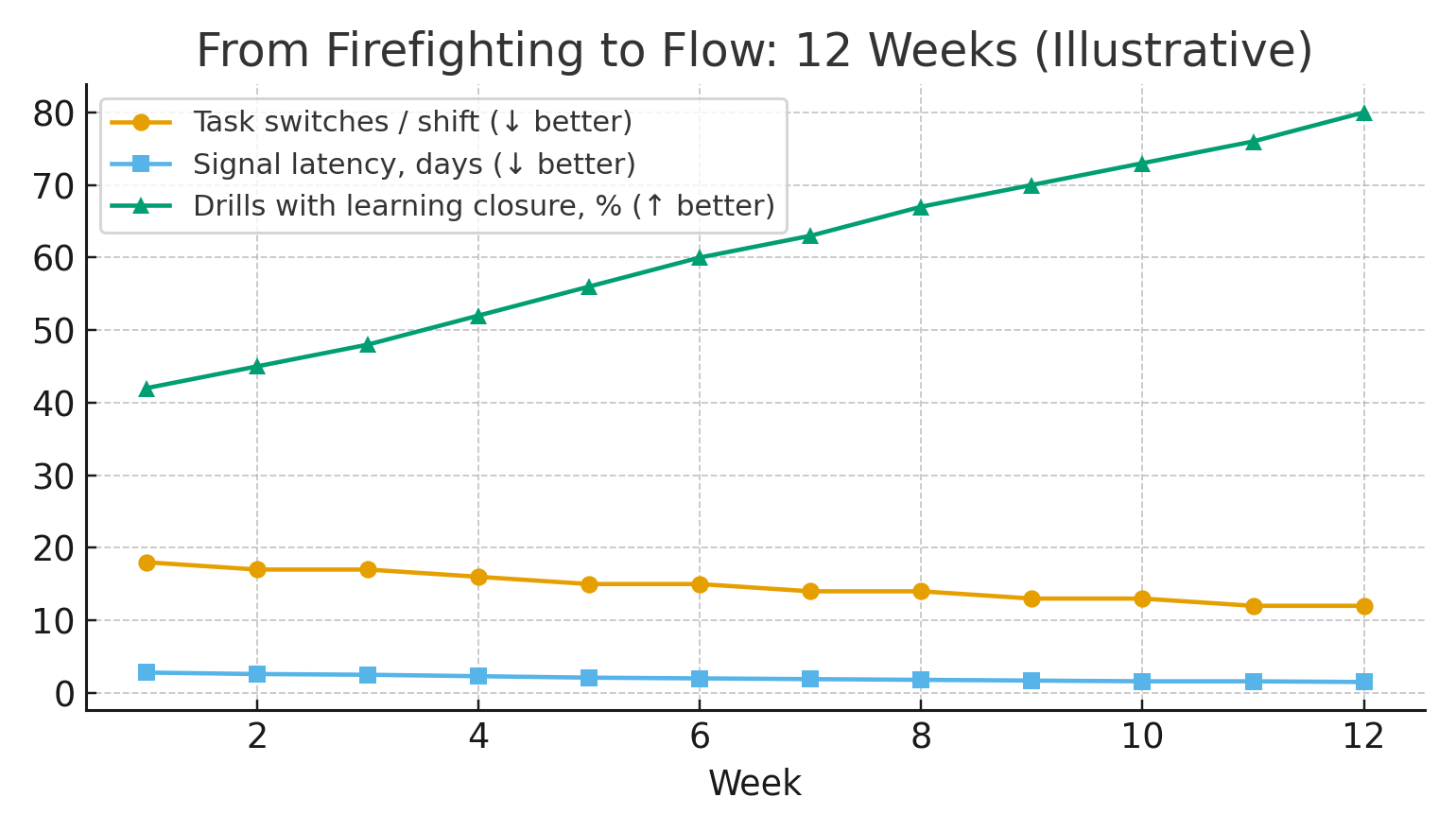
Figure 1. From Firefighting to Flow: 12 Weeks (illustrative). Alt text: Line chart showing task switches and latency trending down, and drills with learning closure trending up.
What changes in the first 12 weeks
• Weeks 1–4: Signal pathways speed up; switching drops as handovers are protected; alarm noise decreases as sources are de-duplicated.
• Weeks 5–8: PDI climbs with 10–15 minute micro-drills tied to credible scenarios; actions start closing with proof.
• Weeks 9–12: Repeat events fall; schedule reliability improves; the week feels calmer.
“Once we capped WIP and protected handovers, task switching fell by a third in four weeks.” — Ops Director, transit (Canada).
“We stopped closing actions on paper; learning closure now means a verified change at the point of work.” — HSE Lead, manufacturing (Canada).
The method—without jargon
• Publish a Signal Charter with latency limits for high-class signals (e.g., 24 h) and report actuals weekly.
• Install pace guardrails: WIP caps, protected handover windows; require senior decision for concurrent critical work.
• Run short, realistic micro-drills; record roles, kit readiness, and learning closure.
• Use a one-page dashboard with triggers: TBI Red → reduce pace ≤48 h; Delta Truth drop → increase sampling and remove bottlenecks; PDI weak → drill now and verify closure next week.
• Prove green: Physical (show the artifact), Recent (≤7 days for criticals), Ownership (named owner + due date).
| BOX A — This week’s TTP checklist (15 minutes) |
|---|
| • Time two high-class signal pathways end-to-end (report → owner → fix). |
| • Protect one 10-minute handover window per shift. |
| • Run one 12-minute micro-drill; log roles, kit, and learning closure. |
| • Close one stale action with proof at the point of work. |
Case slice (Canada): from brittle weeks to calm
A transit depot published a 24-hour Signal Charter for Class-A items, capped WIP at two buses per crew, and protected 10-minute handovers. Delta Truth rose after timestamps exposed a dispatch-to-triage bottleneck; a simple routing tweak cut hours. Micro-drills (door interlocks, brake warning triage, stop-zone incidents) pushed PDI up and reduced duplicate alarms. By week eight: fewer task switches/shift, faster closure on red tags, higher on-time performance.
| BOX B — Canadian context quick links (editor-friendly) |
|---|
| • Wildfire smoke & heat: pair pace guardrails with provincial alerts and Health Canada/CCOHS toolkits. |
| • Opioids at work/naloxone: ensure PDI includes overdose response where required. |
| • Know your duties: verify provincial/territorial reporting obligations via CCOHS legislation pages. |
Avoiding the two traps that sink “safety programs”
• Metric theatre: if “green” doesn’t require visible proof (artifact, recency, ownership), it will drift to green. TTP bans that drift.
• Policy that never reaches the week: translate policy into guardrails, handovers, and drills—changes that survive production pressure.
| BOX C — ROI on one page |
|---|
| • Inputs: payroll P; tempo loss τ; recovered share α; avoided slip; program cost. |
| • Example (conservative): P=$10M, τ=10% ⇒ $1.0M; α=40% ⇒ $400k; avoided slip $100k; program cost $120k ⇒ net ≈ $380k (~3.1×). |
| • Sensitivity: publish low/base/high for τ and α; re-validate quarterly with Finance. |
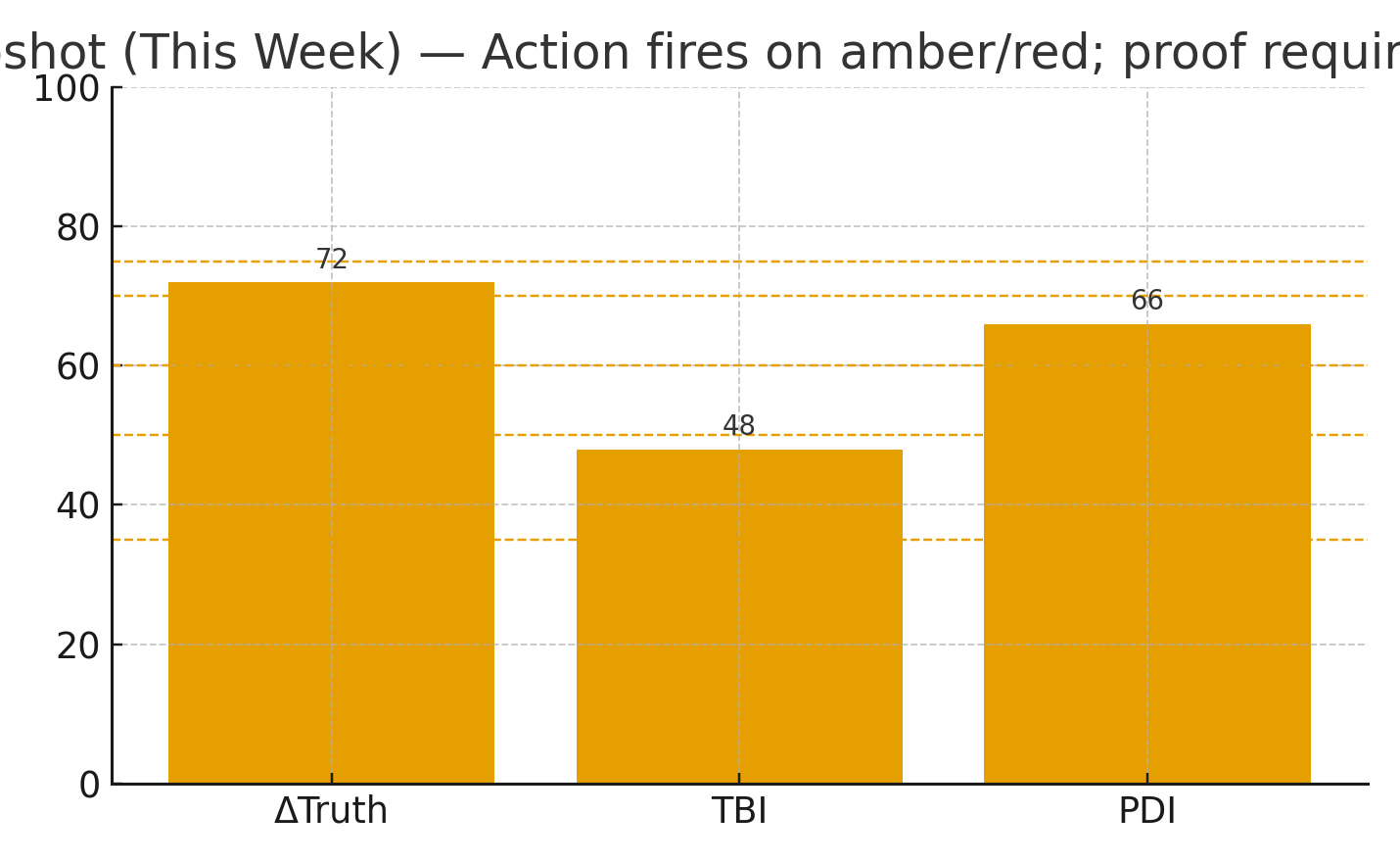
Figure 2. TTP Snapshot (This Week) — three bars (ΔTruth, TBI, PDI) with dashed threshold markers. Alt text: Bar chart with dashed lines marking green/amber/red thresholds; action fires on amber/red; proof required for green.
By the numbers
• Falls remain the leading cause of death in construction; fatal falls to a lower level rose markedly over the past decade.
• Wildfire season typically runs April–October in Canada, often overlapping with heat—plan TBI guardrails and PDI drills accordingly.
• Canada’s 14-jurisdiction OHS landscape makes plain-language, evidence-backed practices essential for cross-site alignment.
The kicker
The most reliable signal isn’t a green dial—it’s a calm Monday. TTP gets you there by governing truth, tempo, and preparation with evidence you can show anyone who asks why.
Author & Contact
Donald P Andrechek, Inventor of the TTP Model, TTP Global
Email: donald@donaldpandrechek.com | Phone: 403 392-1360