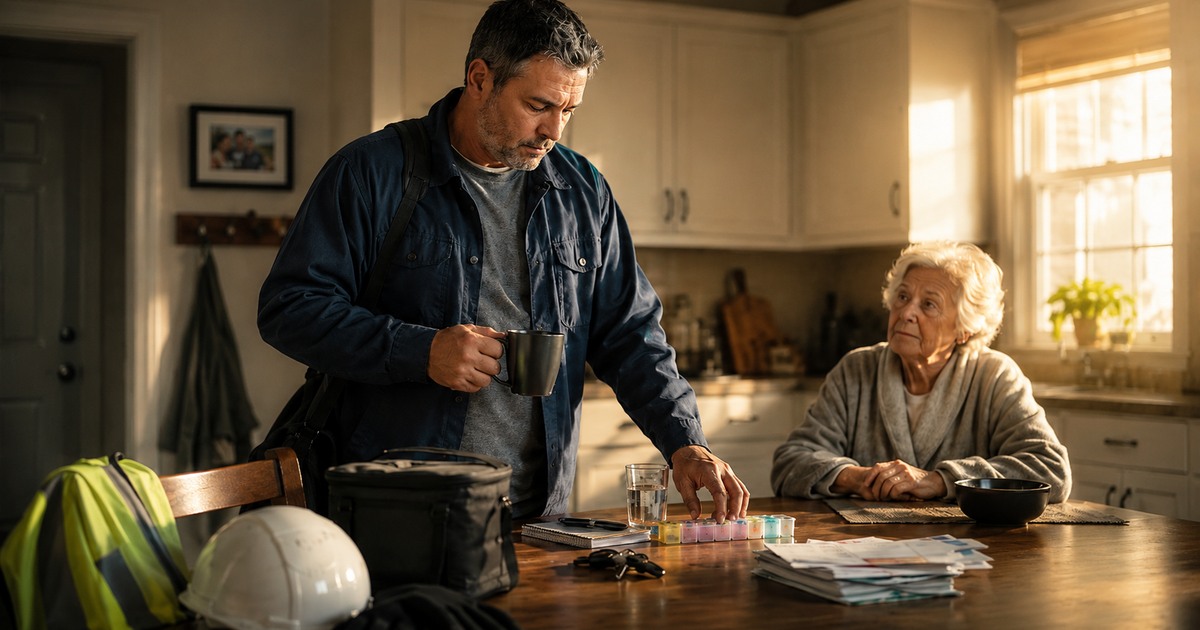
A worker can arrive on time and still have been working for hours.
That is the problem at the centre of Donald P Andrechek's newest OHS Canada article. The paid shift may begin at eight in the morning, but the human being walking through the door may already have spent much of the night dealing with an aging parent's fall, medication, appointment, emergency call, transportation problem or family decision.
The worker may still be experienced. The training may still be current. The procedure may still be correct. What may have changed is the amount of usable human capacity left for the day ahead.
Why aging-parent caregiving belongs in the safety conversation
Family caregiving is often treated as something that ends when the employee arrives at work. Human fatigue does not work that way. Neither do distraction, worry, interrupted sleep or reduced recovery.
Statistics Canada reported that 23 per cent of Canadians aged 15 and older provided care to care-dependent adults in 2022. Among Canadians aged 55 to 64, the proportion was 33.6 per cent. The same national survey found that unpaid caregiving left more than half of caregivers feeling tired, with many also reporting worry, anxiety, feeling overwhelmed and disrupted sleep.
That does not mean a caregiver is automatically unsafe. It means the conditions deserve to be visible.
A signal tells you to look. It does not give you permission to invent the answer.
That distinction runs through the article. A family should not diagnose an aging parent from one forgotten appointment or one fall. A workplace should not label an employee unsafe simply because that person is caring for a parent. Good safety thinking begins with observation, evidence and the conditions that actually exist.
Competence and available capacity are not the same thing
This is one of the most important ideas in the article.
An electrician can still know electrical work. A driver can still know how to drive. A supervisor can still understand the operation. An investigator can still understand evidence. A nurse can still understand the patient.
But knowledge and experience are not the only things required for safe performance. People also need enough rest, attention, recovery, time to think, psychological room, backup and capacity to deal with the unexpected.
The better question is not whether the caregiver remains competent. It is whether enough room remains to perform safely under today's conditions.
Employers do not need to manage the family
The article draws a deliberate boundary around the employer's role. A supervisor does not need a worker's entire family history. A safety professional should not diagnose an employee's parent. A workplace does not need to become a care coordinator.
Its responsibility is narrower. Can an employee raise a temporary concern before it becomes a performance or safety failure? Does the supervisor know what options exist? Can high-risk work, scheduling or workload be reviewed when there is a legitimate concern? Is privacy protected? Are employees aware of available leave, assistance or flexible arrangements where the work allows them?
That is a practical safety question, not an invitation to intrude into private family life.
The TTP test for caregiving pressure
The article applies Truth, Tempo, Preparation and Capacity Margin to a situation that sits partly inside the family and partly inside the workplace.
Truth asks what has actually changed with the parent, the caregiver and the work. What is known and what is still assumption?
Tempo asks how quickly demand is changing. Are care needs growing faster than the family can organize? Is the worker moving from paid work to caregiving and back again without enough recovery?
Preparation asks what can be put in place before the next difficult day: transportation, medical assessment, family responsibilities, community services, workplace conversations, backup and temporary adjustments.
Capacity Margin asks how much usable room remains when something unexpected happens.
This is where the article connects caregiving directly to Donald's wider work on human capacity and system failure. A system can still look compliant while the person inside it has less room than the system assumes.
The workplace needs a safe way to hear the truth
Workers are often told to speak up when something may affect safety. That only works when the system can receive the information without automatically turning honesty into punishment.
An employee may need to say only that something happened overnight, sleep was poor, concentration is affected, an emergency is unfolding or temporary flexibility is needed. What happens next tells the worker whether the reporting system is real.
A mature safety system should be able to recognize that a predictable human condition can change fatigue, concentration, stress, availability and capacity before an incident forces everyone to notice.
Why this publication matters to the aging-parents work
The same pressures explored in When Your Parents Begin to Need You do not remain inside the home. They follow adult children into trucks, offices, job sites, hospitals, classrooms, control rooms and every other place where human judgment matters.
That makes this article a bridge between two bodies of Donald's work: helping families respond earlier when parents begin to need support, and helping organizations recognize changes in human capacity before visible failure.